MUSIC MEDICINE
Music Medicine for Better Brain Health
Oscillo Biosciences is a pre-commercial biosciences company developing music-based interventions to address severe neurodegenerative diseases. By integrating the therapeutic potential of music with the latest advancements in neuroscience and technology, Oscillo Biosciences strives to improve the lives of millions of individuals affected by severe diseases and disorders of the central nervous system.
NEURAL OSCILLATION THEORY
What is Neural Entrainment?
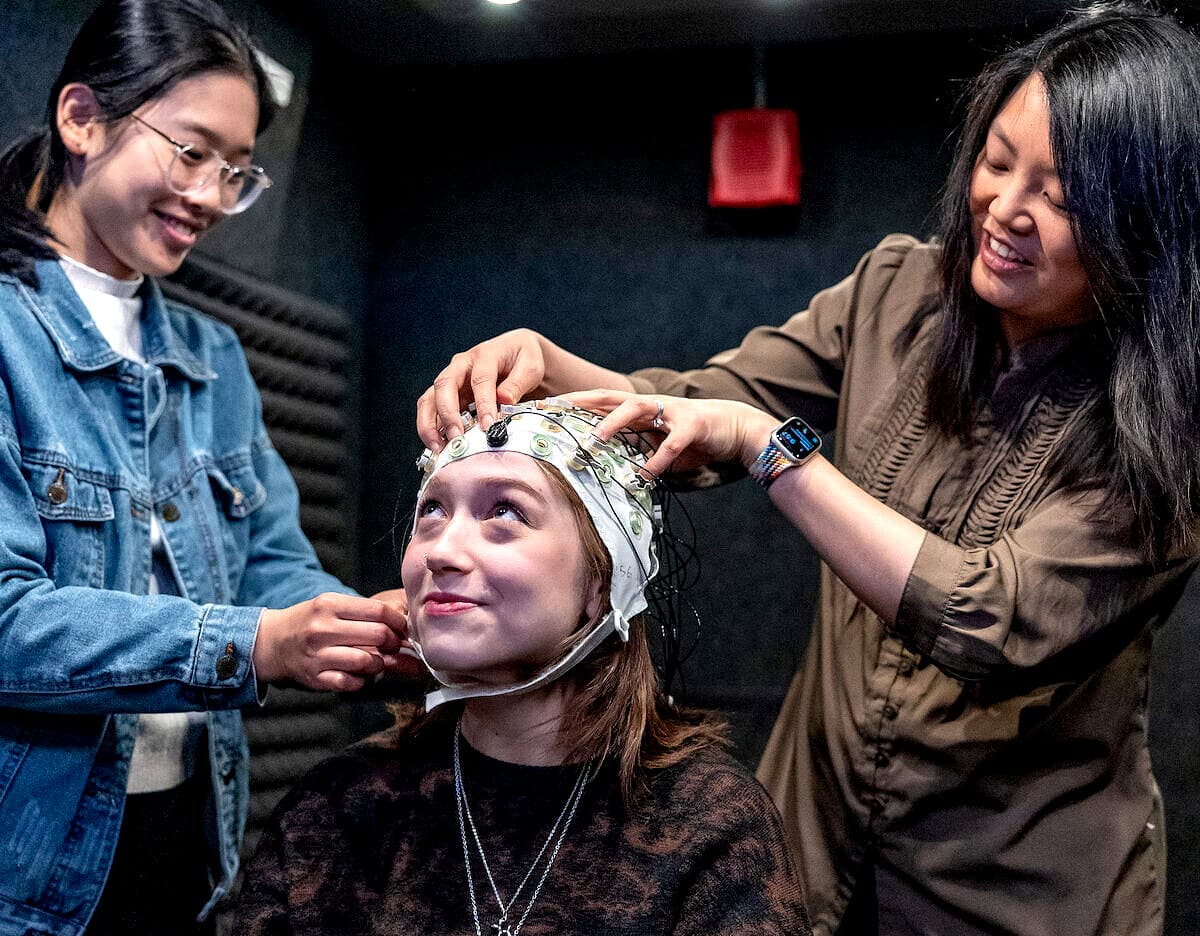
Neural entrainment is the process where neurons synchronize their electrical activity to the rhythm of external stimuli, such as sound, light, or touch. It is a fundamental biophysical mechanism where brain oscillations align to the tempo of sensory input.
THE IMPORTANCE OF GAMMA WAVES
How Gamma Waves Affect Brain Function
Brain waves are patterns of electrical activity produced when large groups of neurons fire together. Brainwaves are categorized into different ranges or frequency bands (gamma, beta, alpha, theta, delta) depending on how fast the neurons are synchronizing their activity. Gamma waves, the highest frequency among these brain waves, form when neural circuits fire very quickly and very precisely together. Gamma waves are vital for high-level brain functioning, serving as the “conductor” for binding information together across the brain. They are essential for cognitive processes like complex task processing, perception, memory, and attention, while also acting as a neuroprotective mechanism against neurodegenerative diseases.
In 2016, MIT researchers Ed Boyden and Li-Huei Tsai, published a paper in Nature¹, showing that gamma wave stimulation of the brain through light, sound, the two combined or tactile vibrations reduced hallmarks of Alzheimer’s pathology in Alzheimer’s mice.
Citation: Iaccarino HF, Singer AC, Martorell AJ, et al. Gamma frequency entrainment attenuates amyloid load and modifies microglia. Nature. 2016;540(7632):230-235.

MUSIC IS MEDICINE
Why Music?
Engages multiple brain systems
Music simultaneously activates auditory, motor, reward, emotion, and memory networks, supporting widespread neural synchronization and cognitive engagement.
Drives neural entrainment
Musical rhythm naturally entrains neural oscillations, particularly in the theta and gamma ranges linked to attention, learning, and memory.
Accessible and enjoyable
Music is universally available, non-invasive, and intrinsically rewarding, promoting motivation and long-term adherence in older adults.
Enhances neuroplasticity
Evidence shows that musical engagement strengthens functional connectivity and promotes plastic changes in aging brains.
Supports emotion and well-being
Music evokes positive affect, reduces anxiety, and fosters social and emotional connection—key factors in maintaining quality of life and resilience in aging.
Bridges science and daily life
By translating mechanistic neuroscience into a familiar, culturally rich experience, music-based interventions make cognitive health care engaging, equitable, and sustainable.
FIGHTING COGNITIVE DECLINE
The Science
Emerging neuroscience suggests that memory and cognition depend on rhythmic synchronization among neural oscillations—particularly the coupling between slower theta (4–8 Hz) and faster gamma (30–80 Hz) rhythms. In aging and Alzheimer’s disease, this theta–gamma coupling becomes disrupted, impairing communication among brain networks critical for memory formation and retrieval. Restoring these oscillatory patterns may therefore present a mechanistic path to slowing or reversing cognitive decline.
Oscillo, in partnership with the MIND Lab (Music, Imaging and Neural Dynamics) at Northeastern University, is conducting an NIH funded clinical trial, Gamma-Music Based Intervention for Mild Alzheimer’s Disease, to study a non-invasive intervention combining rhythmic music with precisely synchronized light stimulation to entrain theta–gamma neural activity. Early results show enhanced theta–gamma phase-amplitude coupling (PAC), improved associative memory, and increased global cognition in adults with early Alzheimer’s disease.
OUR PARTNERS
We're In Good Company
Oscillo Biosciences is proud to collaborate with world-class academic institutions and federal agencies at the forefront of neuroscience research. These partnerships provide the scientific rigor, funding, and infrastructure essential to advancing music-based neurotherapy from bench to bedside.


WORLD-LEADING SCIENTISTS
Built by Leading Music Neuroscientists
Our science team brings together pioneering researchers whose landmark work defines the field of music and brain science — from neural oscillation theory to clinical applications in cognitive health.

Edward W. Large, Ph.D.
Co-Founder & Chief Executive Officer
Dr. Large is a leading theoretical neuroscientist whose work focuses on the dynamics of brain activity underlying music perception, cognition, and emotion. His research integrates nonlinear dynamical systems theory with behavioral experiments and neuroimaging to understand how the brain processes complex, temporally structured sound such as music and speech. He is widely recognized for pioneering the concept that attention and perception are inherently rhythmic processes, and for developing foundational theories—such as neural resonance theory—that explain how brain activity synchronizes with musical structure.
Learn more about Edward→
Ji Chul Kim, Ph.D.
Co-Founder & Chief Science Officer
Dr. Kim is a computational neuroscientist and music psychologist whose work focuses on the dynamics of human perception, action, and cognition. His research applies mathematical and dynamical systems modeling to understand how the brain processes music, coordinates rhythmic movement, and forms complex perceptual and cognitive representations.
Learn more about Ji→
Psyche Loui, Ph.D.
Scientific Advisor & Clinical Trials Lead
Dr. Loui’s research focuses on the neuroscience of music perception and cognition, investigating how brain structure and connectivity give rise to musical experience, emotion, and learning. Her work explores topics such as auditory and multisensory perception, memory for sound, and the role of music in neurological and psychiatric health.
Learn more about Psyche→THE COGNITION CRISIS
Cognitive Impairment is a Growing Global Challenge
JOIN OUR CLINICAL TRIAL
Enroll in our NIH-funded Clinical Trial
Oscillo, in partnership with the Music, Imaging and Neural Dynamics (MIND) lab at Northeastern University, is currently conducting a Phase I Clinical Trial (NCT05984524) in individuals with Mild Cognitive impairment (MCI) and early stage Alzheimer’s Disease (AD).